


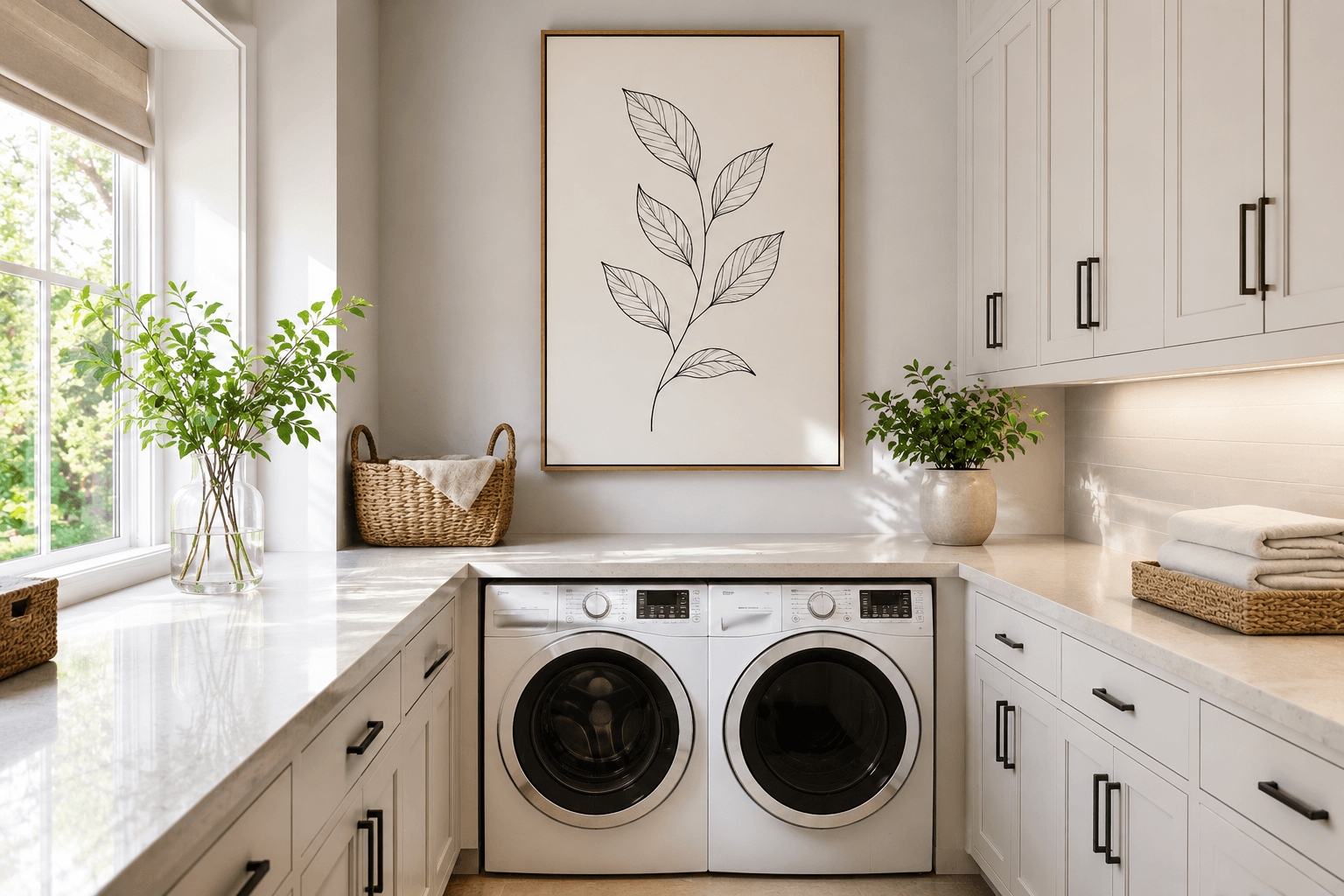
Most laundry rooms get decorated last and thought about least. Then someone hangs a cheap framed print above the machines, and six months later it’s rippled, faded, or peeling at the corners. That’s not bad luck. It’s a room with heat, moisture, and vibration doing exactly what it does to art that wasn’t chosen for it.
Laundry room wall art works best when you treat the space like the small, humid, high-traffic room it is, not like a spare bedroom wall. The short version: pick moisture-resistant materials, keep pieces off direct dryer heat, size them to about 60 to 75 percent of the open wall space, and hang them 57 to 60 inches to the center from the floor, the same eye-level rule designers use everywhere else in the house.
Why Laundry Rooms Are Harder on Art Than Other Rooms
A laundry room isn’t just small. It runs a heat and humidity cycle every time someone does a load. A washer releases warm, damp air during the cycle, and a vented dryer pushes hot air through the room even with good ventilation. Framing experts at Church Hill Classics note that <cite index=”27-1″>the best way to avoid moisture damage is to keep artwork in a well-ventilated area away from humidity, since organic materials like paper can warp and develop mold when they absorb moisture from the air</cite>. Laundry rooms rarely hit that standard. They’re often the most humid room in the house after the bathroom.
That’s the real gap in most laundry room decorating guides. Plenty of sites will show you cute typography prints and clotheslines-and-suds illustrations, but almost none of them mention that a $20 paper print in a basic glass frame is a bad bet in a room where the humidity swings every single day.
Choose Materials That Can Handle Moisture and Heat
This is the part worth getting right before you fall in love with a design. Three material choices hold up noticeably better than the rest:
Canvas wraps without glass. Gallery-wrapped canvas has no glazing to fog or trap condensation, and it tolerates humidity swings better than framed paper. I’ve watched a $45 canvas print survive three years above a top-load washer in a windowless laundry room while a framed paper print two feet away started rippling within a season.
Metal prints or acrylic-face prints. These are essentially waterproof on the surface and wipe clean if detergent splashes or lint dust settles on them. iCanvas and similar print retailers now carry laundry-specific collections in exactly these formats, running roughly $40 to $120 depending on size.
Sealed, moisture-resistant glazing if you must use glass. If you’re set on a framed piece, ask for acrylic glazing instead of standard glass, and request a spacer between the mat and the glazing so air can circulate. That single detail is what most home decor articles skip entirely, and it’s the difference between a print that lasts and one that cockles within a year.
Skip original paper prints, unsealed wood signs, and anything with a fabric mat board unless the room has strong ventilation or a dehumidifier running most days. If you’re comparing different display options for other areas of the home, our wall art frame sizes guide can also help you choose proportions that fit each space before ordering.
Where to Actually Hang It
Laundry rooms have less usable wall space than almost any other room, which makes placement decisions matter more, not less.
Keep art at least 12 inches away from the dryer vent hose and any exposed exhaust ductwork. That’s where heat concentrates, and repeated hot air exposure is what causes wood frames to warp and canvas to loosen over its stretcher bars, a pattern conservators describe as the layers of a piece expanding and contracting at different rates until something gives.
For a single statement piece above a folding counter or between upper cabinets, aim for the standard 57 to 60 inches from the floor to the center of the piece. That’s the same center-height guideline interior designers use in living rooms and hallways, and it keeps the art at eye level rather than crowding the ceiling in a room with lower sightlines.
If your laundry room is genuinely tiny, a single piece almost always looks better than a gallery wall. Multiple small frames read as clutter fast in a 6-by-8 room, while one well-sized piece reads as intentional.
Sizing It to the Wall, Not the Trend
A common mistake is buying whatever size is on sale rather than sizing to the actual wall. The general rule that design retailers use, and that holds up in practice, is that wall art should cover roughly 60 to 75 percent of the available open wall space above a counter or between two fixed points like cabinets or a door frame.
Measure the open wall first. Above a standard 25-inch-deep folding counter with 30 inches of clearance to the upper cabinets, that usually means a piece in the 16-by-20 to 20-by-24 inch range, not the oversized 36-inch canvas that looks great in a showroom photo but overwhelms a narrow utility room. Our wall art frame sizes guide breaks this down room by room if you want exact measurements before you buy.
Style Directions for Laundry Room Wall Art
Typography and wash-day humor. Phrases about suds, sorting, and laundry-day chaos are genuinely the best-selling category in this niche, and they work because they acknowledge the room is a chore space rather than pretending otherwise.
Botanical or minimalist line art. These pair well with white cabinetry and read as calm rather than busy, which matters in a small room you pass through daily.
Vintage laundry signage. French laundry-inspired prints and retro washing symbol charts suit farmhouse and cottage-style homes, and the washing symbol reference charts double as genuinely useful information if anyone in the house still checks garment care tags.
Vintage laundry signage. French laundry-inspired prints and retro washing symbol charts suit farmhouse and cottage-style homes, and the washing symbol reference charts double as genuinely useful information if anyone in the house still checks garment care tags. If you’re unfamiliar with the standardized laundry care symbols, you can review their meanings before choosing decorative prints based on them.
What If You Want a Gallery Wall Anyway
Some laundry rooms are big enough to handle more than one piece, usually anything over roughly 60 square feet with a full run of open wall above the counter. If yours qualifies, keep spacing consistent at 2 to 3 inches between frames, and stick to a single format, either all canvas or all metal, rather than mixing framed glass with unframed canvas. Mixed materials in a small grouping tend to look accidental rather than curated. A three-piece set in matching sizes, hung level with each other along the same horizontal center line, reads as far more intentional than five random pieces at different heights.
Open shelving above the machines is also worth considering instead of a second piece of wall art. A single floating shelf with two or three small items, a plant, a labeled jar, a small print leaning rather than hung, adds texture without adding another thing that needs moisture protection.
Budget Ranges Worth Knowing
Framed prints from general home decor retailers typically start around $65 to $90 for a mid-size piece. Canvas prints from print-on-demand retailers run $35 to $80 depending on size and finish. Custom framing for an existing piece of art, including moisture-appropriate acrylic glazing, generally adds $40 to $120 on top of the print cost. If you’re decorating on a tight budget, a single well-placed $30 to $50 canvas print does more for the room than three cheap dollar-store frames crowded together.
A Few Things Worth Doing Differently
If you’re renovating the room at the same time, hang art after the dryer vent and any exhaust fan are installed and running, not before. That lets you actually feel where warm air moves through the room before committing to placement. And if the laundry room shares a wall with an exterior wall in a humid climate, a small $15 hygrometer on that wall for a week will tell you more about what art will survive there than any decorating guide can.
Frequently Asked Questions
Can I hang regular framed photos in a laundry room?
You can, but standard glass and basic paper mats are the most vulnerable combination to humidity swings. If you want to use photos, choose acrylic glazing over glass and keep the piece away from the dryer vent and any exterior wall prone to condensation.
Does laundry room wall art need to be washable?
It helps. Detergent splashes and dryer lint settle on nearby surfaces over time. Metal prints, acrylic-face prints, and canvas all wipe clean with a barely damp cloth; framed paper prints do not.
What size art works for a small laundry closet?
For a narrow closet-style laundry area, a single 11-by-14 or 12-by-16 piece centered above the machines usually looks more intentional than multiple small pieces, which tend to read as clutter in under 20 square feet of wall.
Is it okay to hang art directly above the washer and dryer?
Yes, as long as it’s centered on open wall space rather than directly over the dryer vent hose, and mounted with anchors rated for the wall material since laundry room walls take more vibration than most.
How often should laundry room art be replaced or checked?
Check framed pieces every six months for early rippling, warping, or foxing spots, especially in the first year in a new location. Canvas and metal prints rarely need this kind of check.
What’s the most durable wall art format for a laundry room overall?
Metal prints and gallery-wrapped canvas consistently outlast framed paper in humid, high-traffic utility rooms, based on how each material responds to repeated humidity swings and heat exposure.
