


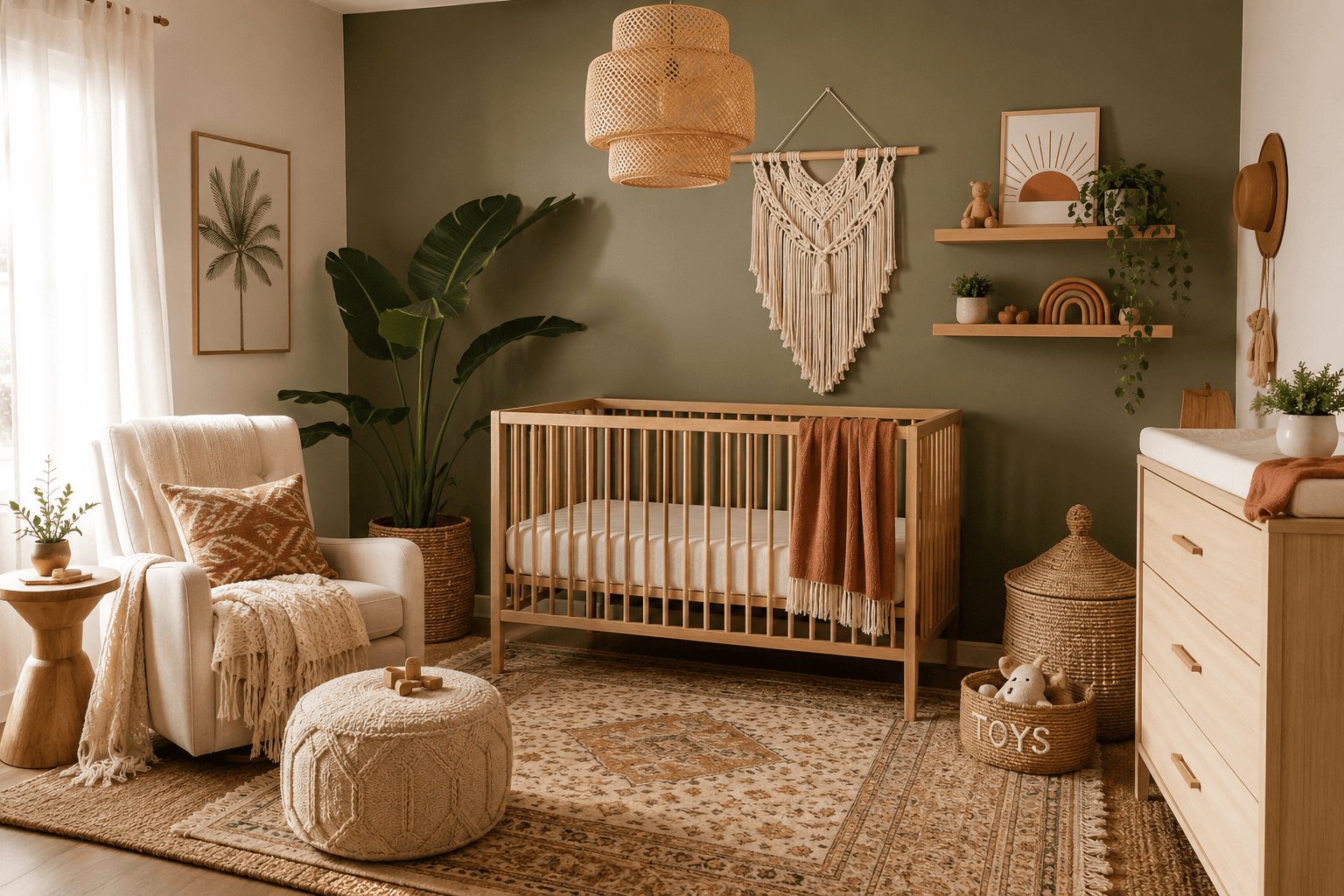
Scroll through enough nursery inspiration and a pattern emerges fast: rattan bassinets, dried pampas grass, macrame hangings, and a crib layered with knit blankets and a plush bumper. It photographs beautifully. Some of it, though, is either discontinued, federally restricted, or simply impractical once an actual baby moves in.
Boho nursery decor is a style built on natural materials, earthy color palettes, and a deliberately unmatched, collected-over-time feel think woven textures, wood tones, and botanical touches rather than a matched crib set from a single catalog page. The honest version of this style works beautifully in a real nursery. The Pinterest version often doesn’t, and this guide covers both what to buy and what to leave out of the crib entirely.
What Makes a Nursery Read as Boho, Not Just Neutral
A lot of “neutral nursery” content and boho nursery content overlap so much that people use the terms interchangeably. They’re not quite the same thing. A neutral nursery is about color (sage, cream, taupe). Boho is about texture and origin story — the sense that pieces were gathered, not ordered as a set.
The core ingredients show up again and again across boho nursery ideas: jute or wool rugs, rattan or wicker furniture pieces, macrame or woven wall hangings, linen or muslin textiles, and a palette pulled from clay, sand, sage, and rust rather than pastel pink or blue. Botanical motifs palm leaves, pampas grass, dried florals recur constantly, and so does mixed metal (brass over chrome, for instance).
What separates a good boho nursery from a cluttered one is restraint. Interior designers who work in this space consistently point to one dominant neutral wall color with texture doing the work of interest, rather than pattern piled on pattern. A single patterned rug, one macrame piece, one textural chair. Not five competing prints in one 10-by-10 room.
The Crib Decor Problem Most Guides Don’t Mention
This is the part that genuinely gets skipped, and it matters more than paint color.
The Safe Sleep for Babies Act, signed into law in 2022, made it illegal to manufacture or sell padded crib bumpers and inclined sleep products in the United States. That’s not a soft recommendation it’s a federal ban, enforced through the CPSC. Yet plenty of “boho nursery” product roundups and Etsy shops still feature padded macrame bumpers, cushioned crib rail covers, and pillow-style crib liners photographed styled inside the crib itself.
Search “boho crib bumper” today and you’ll still find sellers offering them, often through platforms based outside U.S. jurisdiction or listed as “decorative only” a label that doesn’t change how a baby actually interacts with a soft object 18 inches from their face at 2 a.m.
The American Academy of Pediatrics and CPSC guidance is unambiguous: the crib itself should hold nothing but a firm mattress and a fitted sheet. No pillows, no quilts, no bumper pads, no stuffed animals, no pillow-like liners, regardless of how the aesthetic is marketed. Crib slats should sit no more than 2⅜ inches apart about the width of a soda can and the mattress needs to fit snugly enough that two adult fingers can’t slip between it and the frame.
So where does the boho texture go? Outside the crib. A macrame wall hanging above and behind the crib, not draped on the rails. A woven canopy mounted to the ceiling well clear of the sleep space, not attached to the crib itself. A soft mobile hung high and out of grasping reach once baby can push up on hands and knees, generally removed by 5 months. The look survives fully intact. It just moves off the mattress.
Building the Palette Without It Looking Like a Furniture Showroom
A boho nursery color scheme typically starts with a warm neutral base think oatmeal, terracotta, sage, or a soft clay pink and layers in one or two accent tones through textiles rather than paint. Zero-VOC paint is worth the small premium here: by FTC guidance, “zero-VOC” generally means under 5 grams of VOCs per liter in the untinted base, versus up to 250 g/L allowed under EPA rules for standard flat paint. The catch nobody mentions on the can: tinting adds VOCs back in, and darker colors can add 10 g/L or more even with a zero-VOC base.
If you’re set on a moodier clay or rust wall, ask specifically for zero-VOC colorant, not just zero-VOC base paint. Benjamin Moore’s Natura and Sherwin-Williams’ Harmony lines are commonly cited as staying under 5 g/L even tinted. Layering happens through textiles more than furniture: a woven throw over a glider, a linen curtain panel, a jute basket for toys instead of a plastic bin. This is where the “collected, not matched” feeling comes from, and it’s also the cheapest way to commit to the look before buying furniture.
Rugs: The Piece That Sets the Whole Room’s Tone
A large-scale rug, usually a flatweave Moroccan-style or a natural jute weave, tends to anchor a boho nursery layout before any furniture goes in. Two practical notes rarely covered in style roundups: pile height and washability.
High-pile shag rugs look striking in photos but trap dust, crawl awkwardly under a baby learning to move, and are difficult to spot-clean after the inevitable diaper blowout or bottle spill. A low-pile flatweave or a washable printed rug (brands like Ruggable have built an entire category around this) holds up dramatically better once a baby is on the floor daily. Jute is texturally perfect for the aesthetic but can feel rough under bare knees and skin many parents layer a soft washable rug over a smaller jute accent rather than crawling directly on jute.
Wall Decor and the Hanging Rules That Actually Matter
Wall art is where boho nursery decor gets its personality botanical prints, a cluster of woven wall hangings, a single oversized dried-floral piece, or a mural in muted earth tones. Framed pieces should hang with sturdy anti-tip hardware, especially anything positioned over furniture a baby will eventually stand and pull up on. If you’re mapping out sizes and spacing for a gallery-style wall, our guide on choosing the right wall art frame sizes walks through proportion and hanging height in more detail, and the same spacing math applies whether the room is a nursery or a living room.
One safety note specific to nurseries: nothing should hang directly above the crib within reach of a standing toddler, and anything with a cord, string, or wire including macrame plant hangers needs to stay well out of reach once the child is mobile, generally by the time they can pull to stand around 9 to 12 months. If you’re decorating the nursery from scratch, it also helps to understand how different design elements work together throughout the home. This comprehensive home decor guide provides practical ideas that can inspire a warm and cohesive boho space.
Furniture: Where to Spend and Where to Save
Rattan and cane furniture is the signature boho nursery furniture choice bassinets, gliders, and dressers with woven detailing show up constantly in style features. It’s genuinely beautiful, and it’s also more fragile than solid wood in daily use. A cane-front dresser drawer takes more abuse over three years of daily diaper changes than most buyers expect; some parents report loosening or splitting cane panels within the first year of heavy use.
A reasonable middle ground: splurge on rattan for accent pieces that see light contact a chair, a mirror frame, a single accent basket and choose solid wood or a wood-and-cane hybrid for the crib and dresser, which take the most daily wear. This isn’t a hard rule, and plenty of families get years out of an all-rattan set; it depends heavily on the specific piece’s construction quality and how many kids will eventually use it. Many boho furniture pieces are made from rattan because of its lightweight, natural appearance and woven texture. If you’d like to learn more about the material and its traditional uses, this detailed overview of rattan explains its history and characteristics.
Lighting and the Small Details That Finish the Room
Warm, dimmable lighting does more for a boho nursery aesthetic than most decor purchases. Paper or rattan pendant shades, a woven floor lamp, and warm-white bulbs (look for 2700K on the packaging) create the soft, golden feel associated with the style, versus the cooler 3000K–5000K light common in standard overhead fixtures. A dimmer switch or a plug-in dimmable lamp near the glider matters practically too, for middle-of-the-night feeds where full brightness is the last thing anyone wants.
What This Actually Costs
Budget varies enormously, but a rough breakdown for a full boho nursery refresh: a jute or flatweave rug runs $150–$400 for a 5×7, a macrame wall hanging $40–$150 depending on size and whether it’s handmade, a rattan glider or accent chair $300–$900, and zero-VOC paint for one accent wall around $50–$70 per gallon. A full room can reasonably land anywhere from $800 for a thrifted-and-DIY approach to $4,000+ buying new furniture across the board.
The One Thing Worth Doing Before You Buy Anything
Before ordering a single piece, hold every intended crib-adjacent item up to one question: does this go in the crib, on the crib, or near the crib? Items in the first two categories get cut, full stop, no matter how well they photograph. Everything in the third category wall hangings, canopies mounted well above and behind the headboard, floor rugs, gliders is where the entire boho aesthetic can live safely.
Sorting your shopping list this way before you buy anything saves the awkward return process new parents so often go through after a well-meaning baby shower gift turns out to be a banned bumper set in disguise. Once the nursery essentials are in place, you can refine the overall look with timeless decorating ideas. These expert home styling tips can help you create a space that feels both functional and beautifully coordinated.
Frequently Asked Questions
Is boho nursery decor gender-neutral by default?
Generally yes. The earthy, natural palette is one reason it’s a popular choice for parents who don’t know or aren’t sharing the baby’s sex before birth, though accent colors like blush or dusty blue can still be layered in without breaking the look.
Can I still use a macrame crib canopy?
Only if it’s mounted to the ceiling or wall, well clear of the crib itself, not attached to the crib rails or hanging low enough for a baby to grab or pull down.
Is jute or sisal safe for a nursery floor?
Both are safe materials, but they’re coarse underfoot and hard to clean. Most parents layer a softer washable rug over a smaller jute accent rather than covering the whole floor in jute.
Do I need to worry about paint fumes if I’m not pregnant while painting?
VOC off-gassing continues after painting is finished, typically most heavily in the first 24–72 hours but sometimes for weeks in poorly ventilated rooms, so it’s worth painting at least a few weeks before the baby moves in and ventilating well regardless of who does the painting.
