


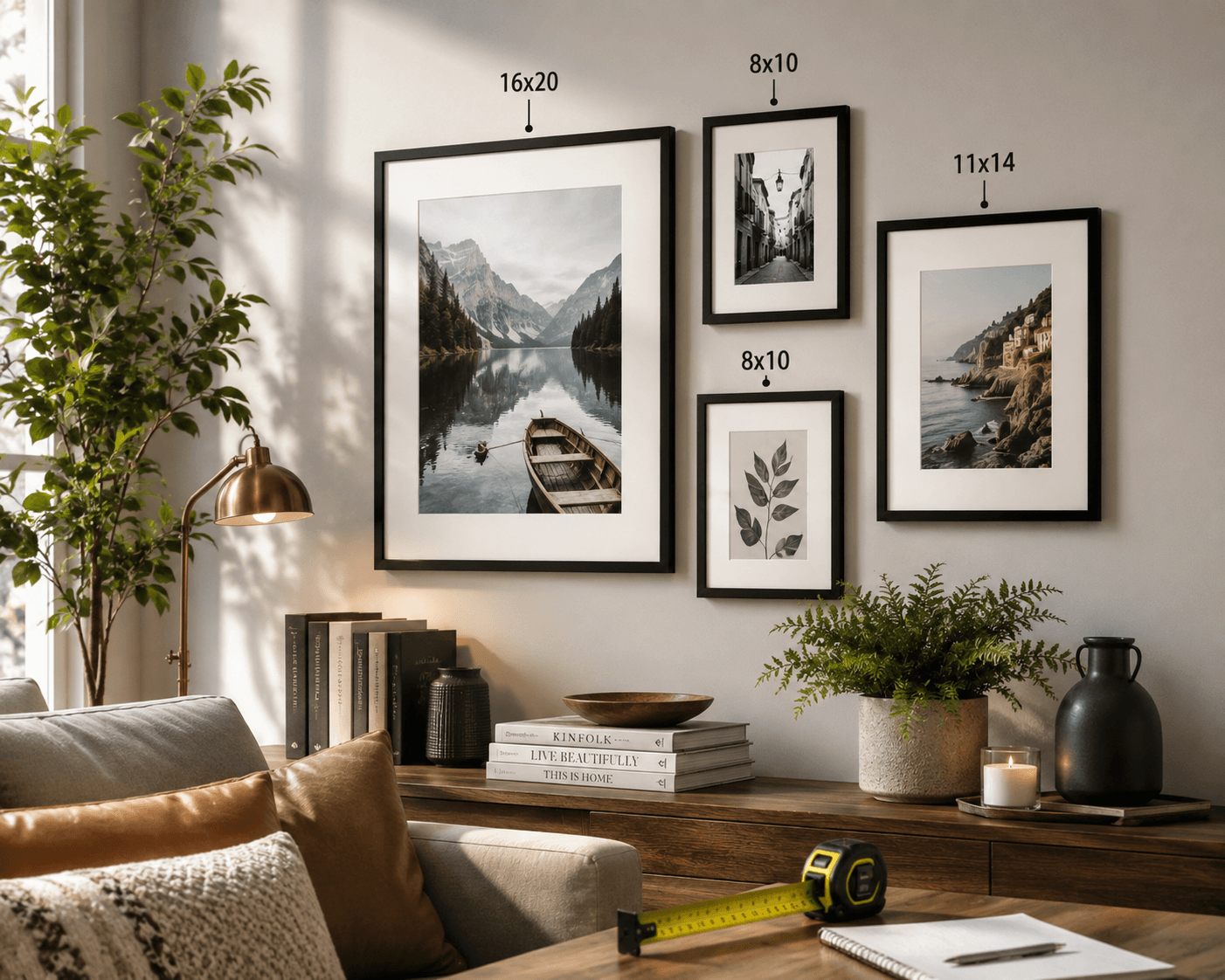
You measured your art, walked into a store, and realized the numbers on the box don’t match what you expected. That mix-up is more common than it should be, because most people assume a frame’s listed size is the outer wood dimension. It isn’t. In almost every case, wall art frame sizes refer to the opening the glass and backing sit inside, meaning the size printed on the box is the size of the artwork it’s built to hold, not the size it will take up on your wall.
That one fact solves half the confusion people run into when shopping for frames, so it’s worth starting there before getting into specific wall art frame sizes and how to match them to your space.
What a Frame Size Actually Measures
A frame labeled 11×14 is built to display an 11×14 print or mat, not to measure 11 inches by 14 inches on the outside. The wood or metal molding around that opening adds anywhere from half an inch to two or three inches per side, depending on the style.
There’s a second detail that trips up first-time framers: the rabbet. This is the small lip, usually 1/8 to 1/4 inch, that sits behind the front edge of the frame and holds the glass, mat, and backing in place. It covers a sliver of your artwork around the border. If you’ve ever had a print where the edge of the image got slightly cut off after framing, this lip is almost always the reason. It’s normal, and most prints are designed with a small margin to account for it, but it matters if your art has important detail right at the edge.
The Sizes You’ll Actually Find on Shelves
When people search for standard wall art frame sizes, they’re usually trying to figure out what’s actually stocked, not just what’s theoretically possible. Retailers stock a fairly narrow band of sizes because they match standard photo paper, poster printing, and mat board cutting equipment. The most common sizes in the US are 5×7, 8×10, 11×14, 16×20, 18×24, 20×30, and 24×36 inches, all measured width by height.
Below 8×10, frames are mostly used for desks, shelves, and small clusters rather than as standalone wall pieces. 8×10 and 11×14 are the workhorses of gallery walls and hallway groupings. Once you get to 16×20 and 18×24, a single piece can anchor a room on its own, which is why these sizes show up constantly above sofas, beds, and consoles. Anything past 24×36 usually has to be special ordered or built custom, since ready-made molding in those dimensions gets expensive to stock and ship.
One frame supplier’s data lines up with what most framing shops report anecdotally: 8×10 and 11×14 remain the single best-selling combination, largely because they’re cheap to print, easy to ship flat, and forgiving if a wall isn’t perfectly measured beforehand.
Why an 8×10 Doesn’t Scale Cleanly to 16×20
This is the part almost nobody explains clearly, and it causes real problems for anyone printing their own art or ordering enlargements. Not every standard size shares the same aspect ratio.
An 8×10 has a ratio of 4:5. A 16×20 is also 4:5, so that jump scales perfectly with no cropping. But a 5×7 has a ratio of 5:7, and an 11×14 is 11:14, which is close to 4:5 but not identical. If you take a photo shot at a 5×7 ratio and try to print it at 8×10 without adjusting the crop, you’ll lose a strip off one side. This is the single most common reason people are unhappy with an enlargement they ordered online. The fix is simple: check the aspect ratio before you scale up, not just the raw dimensions, and crop deliberately rather than letting a print lab do it automatically.
Metric and International Sizes Worth Knowing
If you’re buying frames from a European retailer, working with a designer outside the US, or printing through an international print-on-demand service, you’ll run into the A-series instead of inches. A4 measures 210 × 297 mm (about 8.3 × 11.7 in), A3 is 297 × 420 mm (about 11.7 × 16.5 in), and A2 is 420 × 594 mm (about 16.5 × 23.4 in), based on the ISO 216 international paper size standard used across most of the world outside North America.
A3 sits close to 11×14 but isn’t an exact match, and A2 is close to 16×20 without lining up perfectly either. If a piece of art was designed at a metric size, ordering an inch-based frame and expecting a flush fit usually means trimming the print or accepting a visible gap inside the mat.
How Matting Changes the Finished Dimensions
The size on the frame box already assumes a mat opening in most cases, but the finished look on your wall depends on how wide that mat border is. A standard mat border runs 2 to 3 inches on each side. That means an 11×14 print inside a mat, sitting inside a frame, can occupy close to 16×19 inches of actual wall space once the mat and molding are added together.
This matters for spacing. If you’re planning a gallery wall and only accounting for the print size, and not the mat, you’ll consistently underestimate the true wall art frame sizes you’re actually working with.
Matching Frame Size to Furniture and Wall Space
The most reliable rule for sizing art to a room comes down to proportion, not a fixed number. Framed art hung above a sofa, bed, or console should span roughly 60% to 75% of that furniture’s width.
Here’s the math in practice: a 72-inch-wide sofa multiplied by 0.6 to 0.75 gives a target range of about 43 to 54 inches. A single 24×36 frame won’t fill that on its own, which is why designers often pair a large piece with a smaller companion, or build a three-piece grouping using two 16x20s flanking a 24×36, to reach the right visual width without one oversized frame dominating the space.
For an empty wall with no furniture reference point, the same 60% to 75% guideline applies to the wall’s total width, and the center of the arrangement should sit roughly 57 to 60 inches from the floor, which approximates average eye level in a standing room. If you’re also redesigning the room, these accent wall ideas can help you choose a wall that complements your artwork and creates a balanced focal point.
Hanging Larger Frames Without Wall Damage
Once you move past roughly 16×20, weight becomes a real consideration, not just square footage. A framed piece at 18×24 with glass and a wood frame can weigh anywhere from 3 to 8 pounds depending on materials, and anything at 24×36 or larger often exceeds 10 pounds once glass is involved.
For reference, 3M’s Command strips are rated by pair: their large picture hanging strips hold about 4 pounds per pair, and their extra-large strips are rated for frames up to 24×36 inches and roughly 15 to 20 pounds when using four pairs together. Past that weight or size, the manufacturer recommends switching to stud-mounted hardware or heavier-duty wall anchors rather than relying on adhesive strips alone, since anything valuable, oversized, or overhead shouldn’t depend on adhesive as the sole support.
Standard Sizes vs. Custom Framing: What You Actually Pay For
Standard sizes exist because they’re cheaper to produce at scale, and that price gap is real, not just marketing. A basic 11×14 ready-made frame typically runs $10 to $30 at a home goods store, while a custom frame built to a non-standard size from a local frame shop can run $60 to $150 or more once mat cutting and glazing are factored in, depending on materials and region.
That said, custom sizing isn’t wasted money if your art genuinely doesn’t fit a standard opening, such as a panoramic photo, an oddly proportioned canvas, or a family heirloom with irregular dimensions. In those cases, forcing a standard size means either cropping the art or living with an awkward amount of extra mat on two sides. It depends entirely on what you’re framing. For anything printed specifically for the wall, like a poster or a digital print, it’s almost always worth designing to a standard size from the start rather than paying for a custom cut later.
If you’re planning a full room refresh, pairing your frame choices with a broader layout strategy, like the ideas covered in our accent wall guide, tends to give better results than picking frames in isolation.
The One Thing Worth Doing Before You Buy
Before ordering any frame, tape the exact outer dimensions, mat included, directly onto your wall with painter’s tape and live with it for a day. Print size alone is misleading once mat and molding are added, and a taped mockup catches the kind of wall art frame sizes mistakes that no chart or rule of thumb will catch on its own. It’s a five-minute step that prevents the most common and most expensive framing regret: buying the piece, hanging it, and realizing it reads smaller or larger than you pictured.
Frequently Asked Questions
What is the most common wall art frame size?
8×10 and 11×14 are the most widely sold sizes in the US, largely because they match standard photo printing equipment and mat board cutting machines, keeping production costs low for retailers.
Does frame size include the mat?
No. The listed size refers to the opening for the artwork or mat, not the outer wood dimension. A mat and molding together typically add several inches to the total footprint on your wall.
What size frame should I use above a sofa?
Aim for a frame or grouping that spans 60% to 75% of the sofa’s width. For a standard 72-inch sofa, that’s roughly a 43 to 54-inch-wide arrangement, whether that’s one large frame or several smaller ones.
Can I put an A4 print in a standard US frame?
Not perfectly. A4 is close to but not identical to a letter-sized or 8×10 opening, so you’ll either need an A4-specific frame or a small mat to fill the gap.
How heavy is too heavy for adhesive hanging strips?
Most adhesive strip systems top out around 15 to 20 pounds for their heaviest-duty version, and manufacturers recommend switching to screws or wall anchors above that weight or for anything over roughly 24×36 inches.
