


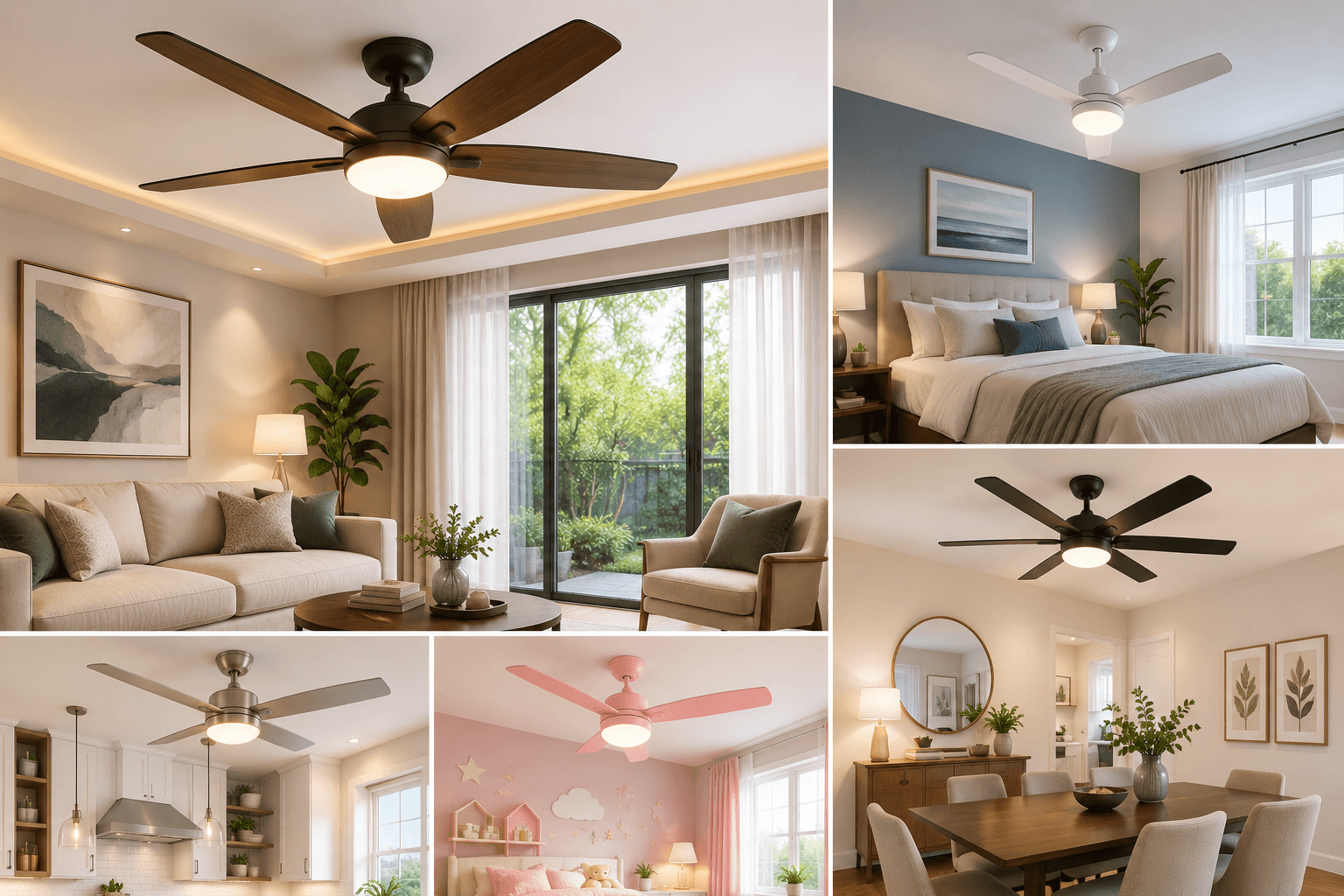
A ceiling fan is one of those home additions that quietly does a lot of heavy lifting. It keeps you cool in summer, helps circulate warm air in winter, and when it comes with a built-in light kit, it also handles your room’s primary lighting. That combination of function and form is exactly why so many homeowners are searching for the best ceiling fans with lights not just any fan, but one that genuinely improves the room it lives in.
The good news is that today’s market has evolved well beyond the wobbly, noise-prone fans of decades past. Modern ceiling fans are quieter, more energy-efficient, and far more stylish than their predecessors. But with hundreds of options available, making the right choice requires knowing what actually matters and what’s just marketing noise.
This guide covers everything you need from motor types and blade spans to lighting options, smart controls, and room-specific picks so you can shop with confidence.
Why a Ceiling Fan with a Light Makes Practical Sense
For most rooms in a home, the ceiling is the logical place for both general lighting and air circulation. Installing them as a single unit saves you an electrical box, reduces ceiling clutter, and often costs less than buying and installing two separate fixtures. If you’re planning multiple home upgrades instead of replacing just a ceiling fan, creating a realistic budget before starting can help you avoid unnecessary expenses and prioritize the improvements that deliver the biggest impact. For bedrooms, living rooms, covered patios, and dining areas, a fan-and-light combo is often the most space-efficient solution available.
Beyond convenience, ceiling fans genuinely reduce energy costs. The U.S. Department of Energy has long noted that using a ceiling fan allows you to raise your thermostat setting by about 4°F with no reduction in comfort during warm months. In winter, running the fan on low speed in reverse pushes warm air that rises to the ceiling back down along the walls. Over a full year, that adds up to meaningful savings.
The best ceiling fans with lights go further by pairing that energy efficiency with LED lighting that consumes a fraction of what traditional bulbs require. A well-chosen unit can handle your room’s air and light needs while running on surprisingly little power.
Understanding Motor Types Before You Buy
The motor is the heart of any ceiling fan, and it’s one area where the differences are not subtle.
AC motors (alternating current) are the traditional choice. They’re reliable, widely available, and often less expensive. Most AC fans offer a few fixed speed settings typically three controlled by a pull chain or wall switch. The tradeoff is that they tend to be slightly less energy-efficient than their modern counterparts and can produce a quiet hum on higher settings.
DC motors (direct current) are the newer technology and generally the better one. They consume up to 70% less energy than AC motors, run almost silently, and typically offer more speed settings sometimes six or more. DC fans also tend to have more powerful motors relative to their size, which means better airflow without the noise. The downside is cost: DC motor fans run higher in price, though that gap has been closing steadily.
When you’re looking at the best ceiling fans with lights for a bedroom or a quiet workspace, a DC motor is almost always worth the upgrade.
Blade Span: Matching the Fan to the Room
Choosing the wrong blade span is one of the most common mistakes people make when buying ceiling fans. A fan that’s too small for the room will strain to move air effectively. One that’s too large can overpower a small space and look out of proportion.
Here’s a straightforward guide:
Rooms up to 75 square feet a small bathroom or a walk-in closet do well with a 29 to 36-inch span. Medium rooms between 76 and 144 square feet, such as most bedrooms, call for a 42 to 52-inch fan. Large living rooms or open-plan spaces between 145 and 225 square feet benefit from a 52 to 60-inch span. For very large or great rooms above 225 square feet, look for fans 60 inches and above, or consider installing two fans rather than one.
Ceiling height matters here too. Standard 8-foot ceilings work fine with most flush-mount or close-to-ceiling designs. Rooms with higher ceilings 9 feet and above should use a downrod to drop the fan to the ideal height of 7 to 9 feet from the floor. That’s the sweet spot for efficient air movement without creating a safety hazard.
Light Kit Options: More Than Just Brightness
When shopping for the best ceiling fans with lights, the lighting component deserves just as much attention as the fan itself.
Most fans today come with integrated LED light kits. These are sealed units built directly into the fan housing they’re energy-efficient, long-lasting, and typically dimmable. The trade-off is that when the LEDs eventually fail (usually after many years), you may need to replace the entire kit rather than just a bulb.
Some fans still use replaceable bulb sockets E26 or candelabra base which gives you more flexibility in choosing bulb type, color temperature, and brightness. This older design is less sleek but more serviceable.
Color temperature is a detail that many buyers overlook until they’re standing in their newly lit room feeling vaguely uncomfortable. Measured in Kelvins (K), light around 2700K to 3000K produces a warm, yellowish tone that works beautifully in bedrooms and living rooms. Light in the 4000K to 5000K range is cooler and crisper better for kitchens, home offices, or task lighting areas.
Dimmability is another must-check item. Not all LED fan light kits are compatible with standard dimmer switches, and even those marketed as dimmable may require a specific dimmer type. Before installing, confirm compatibility between your fan’s light kit, your dimmer, and your home’s wiring setup.
Control Options: Pull Chains, Remotes, and Smart Home Integration
The way you control your fan affects how much you actually enjoy using it. Pull chains are the most basic option reliable, simple, and completely free of connectivity headaches. But they’re also inconvenient when your fan is installed at height, and they offer no flexibility once you’re settled in for the evening.
Remote controls solve that problem elegantly. Most mid-range and premium fans include a handheld remote that controls fan speed, direction, and light on/off or dimming. Some use a wall-mounted receiver that replaces your standard switch.
Smart ceiling fans represent the current cutting edge. The best ceiling fans with lights in the smart category integrate with Amazon Alexa, Google Home, or Apple HomeKit letting you control everything by voice or through an app on your phone. Some models also connect to smart thermostats, automatically adjusting fan speed based on room temperature. Brands like Hunter, Minka-Aire, and Big Ass Fans have strong smart offerings, as does Emerson and Casablanca.
If smart home integration matters to you, confirm that the fan works with your existing ecosystem before buying. A fan labeled “smart” may only work with one platform, not all three.
Style and Finish: Matching Your Interior
Ceiling fans used to be purely functional objects beige or brown, built for utility rather than aesthetics. That’s changed dramatically. Today’s best ceiling fans with lights come in a wide range of styles designed to complement specific interior design directions.
For modern or minimalist spaces, look for fans with slim profiles, clean lines, and finishes like matte black, brushed nickel, or white. Blade designs tend to be simple and sometimes retractable blades that fold in when not in use for a cleaner look. The Monte Carlo Maverick and the Progress Lighting Torque are good examples of this direction.
Farmhouse and coastal styles favor natural materials light wood tones, whitewashed finishes, and simple shiplap-inspired blade designs. Living quarters with exposed beams or shiplap walls find these fans a natural fit.
Traditional rooms call for more ornate options dark bronze or oil-rubbed bronze finishes, carved blade brackets, and light kits that resemble chandeliers or globe-style pendants.
Outdoor-rated fans deserve a separate mention. If you’re looking for the best ceiling fans with lights for a covered porch, pergola, or outdoor living space, you need a fan rated UL Wet or UL Damp. Standard indoor fans will corrode and fail in humid outdoor environments. Wet-rated fans can handle direct moisture; damp-rated fans work in covered areas protected from direct rain.
Energy Efficiency and ENERGY STAR Certification
For buyers who want to minimize their electricity consumption, the ENERGY STAR certification is the most straightforward indicator to look for. ENERGY STAR-certified ceiling fans move air more efficiently delivering more CFM (cubic feet per minute) of airflow per watt consumed than non-certified models.
The CFM rating tells you how much air a fan moves at its highest speed. A higher CFM isn’t always better what matters is the CFM-per-watt ratio, which tells you how efficiently the fan achieves that airflow. Fans with DC motors almost always outperform AC models on this metric.
Among the best ceiling fans with lights available today, DC-motor ENERGY STAR models from brands like Hunter, Craftmade, and Kichler represent an excellent intersection of efficiency, performance, and value.
Top Categories to Consider
Rather than recommending specific models that may change with availability, it’s more useful to understand which categories of fans tend to deliver the best results.
For bedrooms, prioritize quiet operation above everything else. DC motor fans with at least three blade speeds, warm-toned LED lighting, and a remote control create a genuinely restful environment. Look for fans with a sleep mode or timer function if you like to fall asleep with the fan running.
For living rooms, size and style matter most. A 52 to 60-inch fan with a strong CFM rating and a light kit that delivers at least 1,500 lumens ensures the fan can handle both airflow and general room lighting adequately.
For kitchens, consider a flush-mount design with a sealed, easy-to-clean housing kitchens accumulate grease in the air, and fans with elaborate blade designs or open light kits become maintenance challenges over time.
For outdoor spaces, wet or damp ratings are non-negotiable. Beyond that, look for motors rated for humidity and blades made from ABS plastic, acrylic, or other moisture-resistant materials. Teak or treated wood blades also hold up well outdoors.
The best ceiling fans with lights for large open spaces great rooms, loft-style apartments often benefit from dual-motor designs or oversized fans in the 65 to 72-inch range that can genuinely circulate air across a wide footprint.
Installation Considerations
Even the best ceiling fans with lights perform poorly if installed incorrectly. Here are a few things to keep in mind before you commit.
Make sure your ceiling electrical box is rated to support a fan. Standard light fixture boxes aren’t designed for the weight and movement of a fan and can fail over time. Fan-rated boxes are required and aren’t expensive.
Downrod length matters for rooms with higher ceilings. Most fans come with a standard 3 to 6-inch downrod, but you can purchase extensions for vaulted or high ceilings. The goal is to keep the fan blades between 7 and 9 feet from the floor.
For angled or vaulted ceilings, look for fans with a sloped ceiling adapter or a ball-and-socket canopy mount. Not all fans support angled installation, so check the product specifications before purchasing.
If you’re comfortable with basic electrical work, most ceiling fan installations are straightforward DIY projects. For anything involving new wiring, circuit additions, or outdated wiring systems, hiring a licensed electrician is the right call. A ceiling fan installation is often part of a larger renovation project. Following practical home upgrading advice before beginning electrical or structural work can help you schedule projects efficiently, control costs, and avoid unnecessary rework.
What to Budget
Price ranges in this category span a wide spectrum, and more expensive doesn’t always mean better for your specific situation.
Entry-level fans in the $50 to $100 range are serviceable for low-use spaces or tight budgets but often use AC motors, basic light kits, and build quality that shows its limits over time.
The $100 to $250 mid-range is where the best ceiling fans with lights for most homeowners live. You’ll find solid DC motor options, decent light kits, and reliable build quality from trusted brands.
Premium fans from $250 to $600 and above offer exceptional quiet performance, sophisticated smart controls, high-output lighting, and design quality that genuinely elevates a room. These make sense for primary living spaces, master bedrooms, or homes where design consistency matters.
FAQs about Best Ceiling Fans with Lights
How many lumens do I need from a ceiling fan light kit?
For general room lighting, aim for at least 800 lumens for a small room and 1,500 to 2,000 lumens for larger spaces. If the fan is your only light source, lean toward the higher end.
Can I add a light kit to an existing fan that doesn’t have one?
Yes, many fans are designed to accept a light kit as an accessory. Check your fan’s model number and the manufacturer’s website to find compatible kits. Not all fans support this, but many do.
What does “reversible motor” mean, and why does it matter?
A reversible motor lets you switch the fan’s blade rotation direction. Counterclockwise creates a downdraft that cools in summer; clockwise on low speed pushes warm air down in winter. Most quality fans today include this feature.
How often should I clean my ceiling fan?
Dust the blades and light kit every one to two months. Dust accumulation on blades affects both airflow efficiency and light output. A microfiber duster or slightly damp cloth works well. Always turn the fan off completely before cleaning.
Are smart ceiling fans worth the extra cost?
If you’re already using a smart home ecosystem, yes the convenience of voice control and app scheduling is genuinely useful. If you have no smart home setup and don’t plan to build one, a quality remote-controlled fan delivers most of the same convenience at lower cost.
Is it safe to install a ceiling fan without a downrod on an 8-foot ceiling?
Yes. Flush-mount or close-to-ceiling fans are designed for standard 8-foot ceilings and maintain safe clearance between blades and the floor. Just ensure the blades are at least 7 feet from the floor most flush-mount fans achieve this on standard ceilings.
What’s the difference between UL Wet and UL Damp ratings for outdoor fans?
UL Damp means the fan is rated for areas that are humid but not directly exposed to moisture — covered porches, for example. UL Wet means the fan can handle direct contact with rain and moisture. Always use at minimum a damp-rated fan outdoors, and a wet-rated one anywhere that gets direct precipitation.
How long do ceiling fans typically last?
A quality ceiling fan with proper installation and occasional maintenance can last 10 to 15 years or more. DC motor fans tend to have longer lifespans than AC models. LED light kits in integrated designs typically last 25,000 to 50,000 hours before they need attention.
