


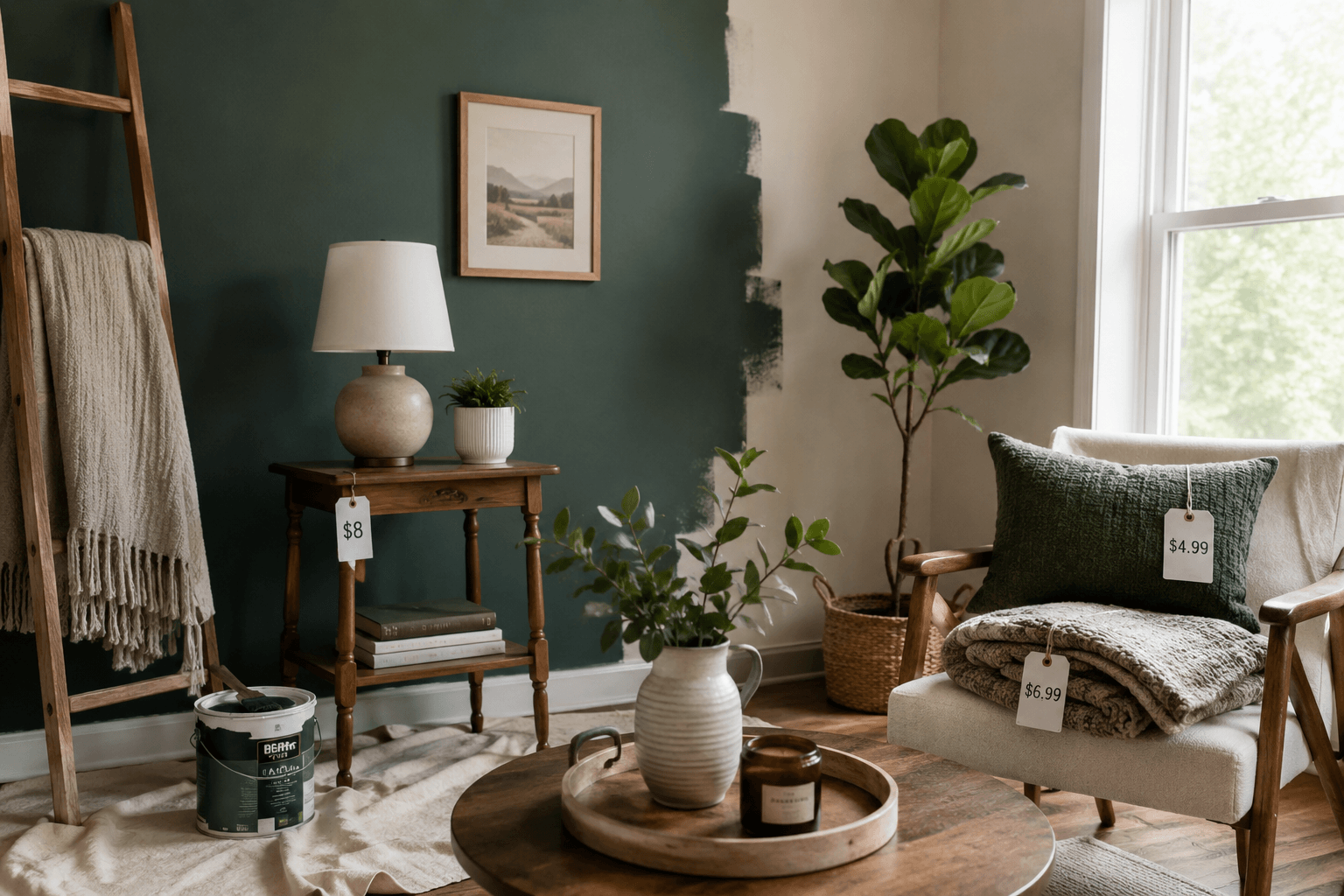
Here’s the thing nobody tells you upfront: most rooms don’t look cheap because of what’s missing. They look cheap because of what’s left half-finished. A bare wall, mismatched hardware, or a couch with no texture around it will drag down a room faster than an empty budget ever will.
The most effective home decor ideas on a low budget focus on three things: paint, layering (rugs, pillows, throws), and fixing small details like hardware and lighting, rather than buying new furniture. You can genuinely transform a room for $50 to $150 if you spend it in the right order.
I’ve redone three rental rooms and one starter home living room on tight budgets over the past few years, and the pattern is always the same. The rooms that felt “done” weren’t the ones with the most stuff. They were the ones where every dollar went somewhere visible.
The One Question To Ask Before You Spend Anything
Before buying a single item, walk into the room and ask: what does my eye land on first, and is that a good thing?
In most rooms, the answer is a bare wall, an overhead light with a builder-grade fixture, or an empty corner. That’s your starting point, not the item you like most on Pinterest. Spending your first $30 on a throw pillow when the real problem is a glaring bare bulb overhead is money that won’t show up in how the room feels.
A simple way to triage: stand in the doorway and rank what bothers you most to least. Fix the top two things first. Everything below that is optional styling, and it’s where most people overspend without meaning to.
What $20 Can Actually Do
Twenty dollars sounds small, but it covers more than people expect if you’re specific about it.
- A can of spray paint ($6 to $10) can turn a dated brass lamp base, a plastic planter, or old picture frames into something that looks intentional. Matte black and brushed brass are the two finishes that read as “expensive” right now.
- A pack of drawer pulls from a hardware store clearance bin, roughly $1.50 to $3 each, can update a dresser or kitchen cabinets for under $20 total on a small piece.
- A single stem of dried pampas grass or eucalyptus in a jar you already own costs $4 to $8 and fills an empty corner better than most small tchotchkes.
- Command strip picture ledges ($8 to $12 for a pack) let you lean art instead of framing and hanging it, which is both cheaper and renter-friendly.
None of these individually transform a room. Combined, they close the small gaps that make a space look unfinished.
What $50 Can Actually Do
At $50 you can start layering, which is where rooms actually start to look pulled together.
A quart of paint (roughly $12 to $20 depending on brand) is enough to do an accent wall in a small bedroom or bathroom, or to repaint a piece of furniture entirely. Behr and Valspar tend to sit at the lower end of that range; Benjamin Moore and Sherwin-Williams run higher.
With the rest, a secondhand throw blanket from a thrift store ($5 to $10), two accent pillow covers ($8 to $15 each if you skip buying new inserts and reuse old pillows inside), and a $10 to $15 framed print from a discount or clearance section can round out a sitting area.
This is also the price point where a small area rug from a marketplace or estate sale, not a big box store, starts to appear. Vintage rugs in awkward sizes (like a 3×5 runner instead of a standard 5×7) are consistently the cheapest, because fewer people are shopping for that exact size.
What $100 Can Actually Do
At $100, you can usually cover an entire small room’s worth of visible upgrades, and this is where the paint math really pays off. A gallon of decent interior latex paint costs $20 to $50, and one gallon covers roughly 350 to 400 square feet per coat, enough for most bedrooms with a coat to spare. That means a full-room paint refresh, not just an accent wall, is realistically a $30 to $60 line item if you’re doing the labor yourself.
Split $100 like this for a bedroom or living room corner: $40 on paint, $25 on a secondhand or discount-rack piece of furniture (a side table, a stool, a small shelf), $20 on new hardware or a lighting swap like a plug-in sconce, and $15 on soft goods like a pillow cover or small throw.
The reason this works better than spending $100 on decor objects is that paint and lighting change how light bounces around the entire room. A single piece of wall art, even a nice one, only changes one sightline.
Paint Is Still The Best Dollar-For-Dollar Upgrade
If you only do one thing from this list, make it paint. Nothing else moves the needle per dollar spent the way paint does. Professional interior painting runs $2 to $6 per square foot once you factor in labor, according to HGTV’s budget decorating guide, but doing it yourself strips out that labor cost entirely and leaves you paying only for the paint and basic supplies, usually $150 to $300 total for tape, rollers, and drop cloths if you don’t already own them.
A few honest notes here. Flat and matte finishes are the cheapest, often $15 to $30 a gallon, but they scuff more easily and aren’t ideal for hallways or kids’ rooms. Eggshell or satin costs a bit more and holds up much better in high-traffic spaces. If you’re painting a rental, ask your landlord before committing to a bold color. Many will allow it if you agree to repaint back to a neutral before move-out, and that conversation is worth having before you buy the paint, not after.
One thing that surprised me the first time I repainted a rental bedroom: the color looked completely different by 7 p.m. than it did at noon. Always test a swatch on the actual wall and look at it morning, afternoon, and evening before committing to a full can.
Where Thrifting Actually Pays Off, And Where It Doesn’t
Secondhand shopping gets recommended constantly for budget-friendly home decorating, but not every category is worth the hunt. Learning more about secondhand shopping can also help you understand why certain used pieces offer better value than buying new.
Thrift stores and estate sales are genuinely good for solid wood furniture, glassware, vases, picture frames, and textiles like curtains or table runners that can be cut down or repurposed. These items were often made better decades ago than their modern low-cost equivalents, and the wear reads as character rather than damage.
They’re a weaker bet for upholstered furniture unless you’re prepared to reupholster it, since you can’t verify what’s inside cushions or how worn the frame is. Mattresses and box springs are a hard no regardless of price. And small electronics like lamps should be tested in-store when possible, since a rewiring job can quickly erase any savings.
The best days to thrift for decor are typically early in the week, right after weekend donations get sorted and priced, and near the end of the month when some stores run color-tag discounts to clear inventory.
Room-By-Room Quick Wins
These are some of the easiest home decor ideas on a low budget to execute in a single afternoon, room by room.
Living room: Rearranging existing furniture costs nothing and is the single most underused trick. Pulling a couch a few inches off the wall and angling it toward a focal point instantly makes a room feel more considered.
Bedroom: A duvet cover swap, roughly $25 to $40 for a decent one on sale, changes the entire feel of the room without the storage headache of owning multiple comforters.
Bathroom: New towels and a bath mat, $20 to $35 total from a clearance section, do more visual work here than almost anywhere else in the house because the room is small and every surface is visible at once.
Kitchen: Open shelving or a windowsill styled with two or three plants and a small stack of cookbooks costs almost nothing if you already own the items, and it fills the visual gap above counters that otherwise looks unfinished.
Entryway: A wicker basket for shoes or mail, often $10 to $18 secondhand, solves clutter and adds texture in one move.
If you’re weighing frame sizes for any of these spaces, our wall art frame sizes guide walks through what actually fits above a sofa, dresser, or bed without looking undersized. And if you’re tackling a nursery specifically, the budget logic works a little differently because of safety rules around what can hang near a crib, which we cover in our boho nursery decor guide.
Decor Mistakes That Waste A Tight Budget
Buying matching decor sets is one of the most common ones. A three-piece matching vase set from a big box store often costs more than three individually sourced pieces, and it tends to look more staged, not less.
Skipping the return policy check is another. Impulse-buying a piece of wall art or a small furniture item without confirming you can return it if it doesn’t fit the space wastes more budget-conscious shoppers’ money than almost anything else, because it often gets shoved in a closet instead of used.
Over-scaling small items is a third. A single small frame or a tiny plant on a large empty wall reads as an afterthought rather than a finished look. It’s genuinely better to leave a wall bare and save for one larger piece than to hang something undersized just to fill the space.
The One Thing Most Guides Skip
Set a per-room budget cap before you start, and write down what you’ve spent as you go, even loosely on your phone’s notes app. Almost every over-budget decorating project I’ve seen didn’t happen because of one big purchase. It happened because five small “it’s only $12” purchases added up over a few weeks without anyone tracking them. A $100 room budget quietly becomes $180 one candle and one throw pillow at a time. Tracking it, even badly, is the cheapest decorating tool you’ll use.
Frequently Asked Questions
How much does it realistically cost to pull off home decor ideas on a low budget?
A meaningful refresh of one room, paint plus a few soft goods and small furniture pieces, typically runs $100 to $250 if you do the labor yourself and mix in secondhand finds. A full furniture replacement pushes that number much higher.
Is it cheaper to paint a room myself or hire someone?
DIY interior painting usually costs $150 to $300 total for a single room including supplies. Hiring a professional runs $2 to $6 per square foot, which can put a single bedroom at $300 to $800 or more once labor is included.
What’s the single cheapest way to make a rental feel less bare?
Layering textiles, a throw blanket, pillow covers, and a small rug, gets you the most visible change for under $50 without touching the walls or needing landlord approval.
Should I buy new furniture or refinish what I already have?
If the piece is structurally solid, refinishing with paint or new hardware almost always costs less than replacing it and often looks more custom. Structural damage like a wobbly frame or broken joints is where replacement usually wins.
Do peel-and-stick options actually work for a low budget refresh?
Peel-and-stick wallpaper and tile are useful for renters specifically, but budget-wise they often cost more per square foot than paint. Use them where paint isn’t an option, not as your default choice.
